Quantum Universe
Cluster of ExcellenceQuantum Universe
Photo: UHH/Laura Vogiatzis
16 June 2026

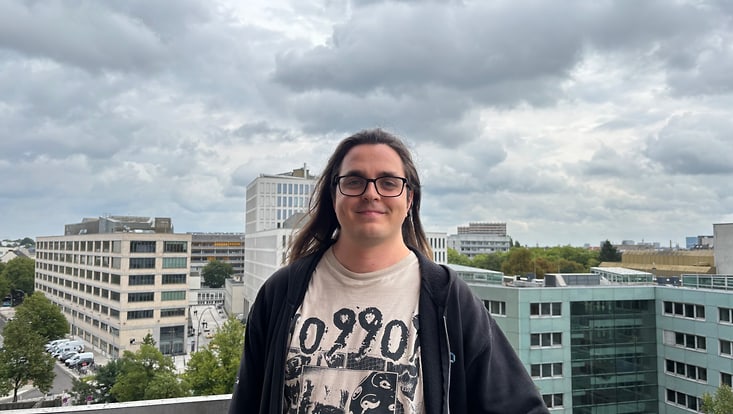
Photo: Wendy Wallace
For the past few years, Wendy has used Machine Learning to study neutron stars. After a year as a research assistant at NASA’s Goddard Space Flight Center, she is moving to Hamburg to use her experience in machine learning to understand more about the structures connecting galaxies, called cosmic filaments.
After completing my master’s degree at the University of Bath in the UK, I worked for a year as a research assistant at NASA’s Goddard Space Flight Center. My work up until now has broadly revolved around neutron stars, high-energy transients, and using machine learning (ML) to accelerate the way we learn about these objects/phenomena. Experience with ML is what connects my previous work to my PhD work, as I am now working with Prof. Dr. Luisa Lucie-Smith to use ML to study cosmic filaments. What’s exciting is that the question of how to characterize large-scale filaments and their potential as a cosmological probe is relatively uncertain and only lightly explored, so I feel like I have many opportunities to really shape my own project.
I chose to pursue a PhD because I hope to make research/academia my career in the future. I am always amazed by the fact that there will always be things that we don’t know, but it keeps the work interesting, and I enjoy a challenge. Starting my PhD feels like a privilege because 1) I understand that there are many who want to but are unable to take the time to complete a higher degree, and 2) even for those who can viably do a PhD, there are simply too many extremely qualified candidates for so few spaces.
I moved to Hamburg at the beginning of October 2025, and so far I have been enjoying it—this is also my first time in Germany! It’s a much more international city than I expected, and I’ve found people to be very friendly. I’m looking forward to the summer months to maybe try out some paddling on the Alster and to generally explore the different events happening around the city.
When applying for a PhD, do your research (not just the scientific kind, although showcase that too). For example, I think it’s really helpful to speak with current and/or past PhD students from the group you are applying to so that you can get a grasp on whether the atmosphere and supervision style would work for you. Everyone is different, and PhDs are challenging on their own—there's no reason to put yourself in a situation that makes the experience harder than it has to be!