Research Area Structures, Methods, Advanced Research Technologies (SMART)
State-of-the-art research needs state-of the-art research infrastructures and methodological know-how. Frequently, both elements serve more than one research goal and therefore – especially today – have to be developed from a broad, possibly common perspective. Recognizing its growing importance, the cluster therefore emphasized and implemented from the very beginning four cross-disciplinary research fields. They serve the entire cluster, link the research areas and promote interdisciplinary research and development.
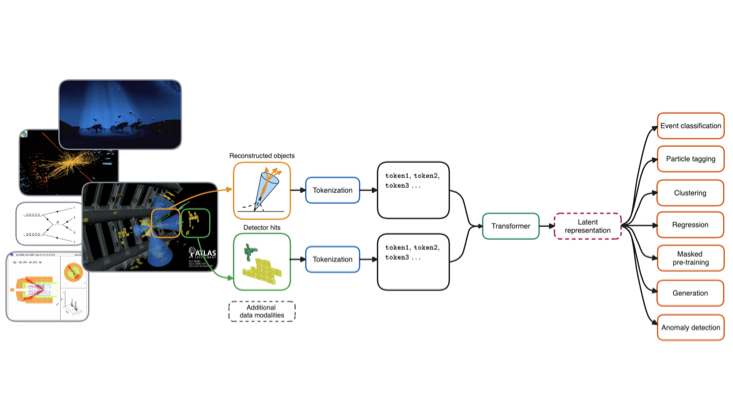
Photo: Gregor Kasieczka
Architecture of the proposed foundation model
Concretely the three fields of focus are:
Algebraic and Geometric Structures
The development of new, innovative mathematical techniques is of similar importance for all areas of the cluster. This ranges from state-of-the-art research in pure mathematics exploring novel structures in algebra and geometry to numerical and analytic developments in classical relativity and gravitational wave applications. The platform tightly links these endeavors and establishes the connection to the two research centers, the Wolfgang Pauli Center for Theoretical Physics and the Center for Mathematical Physics.
Artificial Intelligence
The ongoing AI revolution will lead to profound changes at all levels of society, technology, and scientific research. The science of Quantum Universe plays an important role in this transformation: Decades of experience with Big Data and algorithmic work have made particle physics and astronomy leading adopters and natural beneficiaries of new algorithmic techniques. This is reflected in the deep integration of AI techniques into all aspects of the Cluster's research. As AI techniques become more sophisticated, methods from mathematics and physics inspire the development of physically motivated algorithms and provide tools for studying complex systems. In Quantum Universe, innovative and competitive AI technologies are developed, including novel foundation models and generative AI models, with a wide range of applications in all areas of the Cluster and beyond. Further, a hub for ultra-fast ML techniques with wide applications, such as collider physics and seismic noise control will be implemented.
Detectors, Quantum Sensors, and Accelerators
The second quantum revolution arrived in the development of new detection devices in almost all fields of fundamental research. In addition, two experimental labs were constructed and are running: the Cryogenic Detector Laboratory where large-scale experiments with needs for cryogenics (ALPS II, MADMAX, GW experiments) are or will be hosted, and the Shielded Experimental Hall with low seismic and electromagnetic noise used for the installation for the prototypes of the Dark Matter experiments MADMAX and BRASS. Superconducting radio frequency (SRF) and quantum sensors for applications in DM and GW detectors will be qualified, detector concepts based on extreme spatial granularity and time resolution will be optimized to operate at a circular electron-positron collider, and acceleration technologies towards future colliders will be pursued. This research area is devoted to creating new docking points for transfer of knowledge out of the Cluster.
People Involved
Area Coordinator: Gregor Kasieczka
Principal Investigators: Ties Behnke, Freya Blekman, Marcus Brüggen, Vicente Cortés, Tobias Dyckerhoff, Erika Garutti, Oliver Gerberding, Christophe Grojean, Florian Grüner, Caren Hagner, Johannes Haller, Sarah Heim, Julian Holstein, Dieter Horns, Gregor Kasieczka, Axel Lindner, Luisa Lucie-Smith, Gudrid Moortgat-Pick, Kostas Nikolopoulos, Rafael Porto, Ingo Runkel, Roman Schnabel, Volker Schomerus, Christoph Schweigert, Jörg Teschner, Paul Wedrich, Timo Weigand, Alexander Westphal
Key Researchers: Matteo Bonanomi, Frank Gaede, Wolfgang Hillert, Friederike Januschek, Craig Lawrie, Jenny List, Sven-Olaf Moch, Sven Möller, Christoph Reinhardt, David Reutter, Jan-Torge Schindler, Matthias Schröder, Jörn Schwandt, Felix Sefkow, Georg Steinbrück, Marc Wenskat, Max Wiesner