Quantum Universe
Cluster of ExcellenceQuantum Universe
Photo: UHH/Laura Vogiatzis
16 June 2026

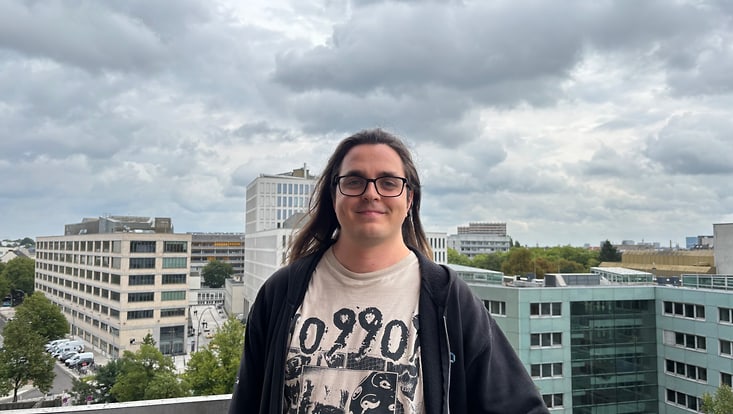
Photo: Mahtab Jalal Vandi
Mahtab was captured by the scientific atmosphere at DESY through the DESY Summer Student Program, which she attended remotely from Iran. Inspired by the scientific environment and research opportunities in Hamburg, she later joined the group of Kostas Nikolopoulos at the University of Hamburg as a PhD researcher. As part of the CMS Collaboration at CERN, she studies rare Higgs boson decays to light hadronically decaying resonances and contributes to the Level-1 Trigger system. Mahtab is also one of the few people who enjoy Hamburg’s grey weather. Read more on what she has to say about her work, Hamburg, and more.
I am hunting for the Higgs boson, one of the most fundamental building blocks of our universe, and trying to understand how it interacts with other particles in ways we’ve never observed before. What really excites me is that these are genuinely rare processes. We are searching for signals that are incredibly hard to isolate, and the trigger work means I am also contributing to the real-time decision-making infrastructure of the experiment. It feels like working at two very different but complementary scales at once.
What drew me to QU is how much it genuinely invests in its graduate researchers. There are so many programs and opportunities specifically designed to support PhD students, and that sense of being valued not just as a researcher but as a person building a career made a real difference to me when I was deciding where to go.
I’ll admit I might be in the minority here, but I actually love the weather! There’s something about grey skies and the wind coming off the Elbe. And Hamburg itself is so alive. It sits at the heart of Europe, there’s always something happening. I never feel like things are standing still here.
Honestly, it's a real mix. Some days are stressful: code that won't behave, results that raise more questions than answers. Other days are relaxed, and then there are moments that are just enjoyable, when something clicks or a discussion with a colleague sparks a new idea. I think that variety is actually part of what makes it interesting. No two weeks feel quite the same.