Quantum Universe
Cluster of ExcellenceQuantum Universe
Photo: UHH/Denstorf
18 June 2026
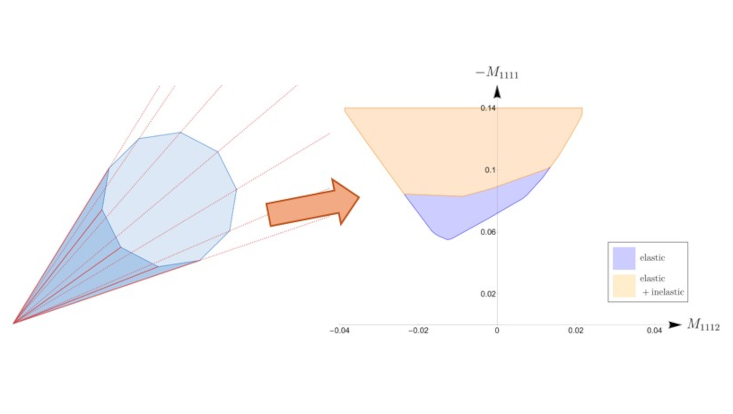
Photo: Q. Bonnefoy et.al (2025)
Paula Pilatus has been a PhD student at Quantum Universe since October 2022 and conducts research at the intersection of mathematics and physics. Her background is a perfect fit: with a bachelor’s degree in physics and mathematics and a master’s degree in mathematical and theoretical physics from Munich, she is ideally suited to reformulate physics problems using mathematics—and thereby gain a deeper understanding of it.
Together with a team of five mathematicians and physicists— including a Master student, a PhD student and a postdoctoral researcher within Quantum Universe — Paula recently published a paper that was awarded the Best Paper Award. Their work explores how so-called effective field theories, which describe physics at low energies, can be mathematically extended to make more precise predictions at higher energies.
The point is that several theories, used for example in particle physics and cosmology, are only valid within a certain energy range. Paula’s work takes these theories, supplements them with parameters, specifies the parameters according to physical conditions/boundary conditions (which are called positivity bounds) and thereby draws conclusions about how the theory behaves at higher energies.
These parameters behave toward high energy in the same way as parameters in hydrodynamics. Although hydrodynamics cannot describe how water molecules interact with one another, we can take a single parameter such as viscosity and thereby gain insight into how strongly the individual molecules of the liquid stick to one another.
To picture the described mathematical approach, imagine a soccer field with a golf ball lying on it. Physics wants to understand where the golf ball is and, without help from a mathematical framework, would have to search the entire field and take measurements at every location to see if the golf ball is there.
The method Paula uses helps narrow down the search area by translating the problem mathematically. This allows her to identify a smaller region where the golf ball must be located. In her case, the region takes the shape of a cone.
The constraint to this region is due to the requirement that the theory at higher energies should obey the following fundamental principles: locality, meaning that particles can only influence each other if they are spatially and temporally close to one another; unitarity, meaning that probabilities are conserved and ultimately add up to 100%; and causality, meaning that information cannot travel faster than the speed of light.
This work takes these boundary conditions and translates them into the mathematical field of geometry in order to examine the cone more closely and describe it in greater detail using inequalities. These inequalities lead to a further cone, which provides insights into the first cone regarding where the golf ball must be located and further narrows down the possible range.
One application is, for example, the Standard Model, which does not yet fully describe our world and is merely a theory that does not yet perfectly account for the high energies that interest Paula. Even though high energies have already been investigated, exactly what happens when these are raised even higher (for example, for High Luminosity) is still unclear. And Paula’s research is dedicated to figuring out exactly how to investigate these higher energies.
Overall, one can say that in the research, Paula and her co-authors take a problem from physics, translates it into an abstract mathematical space (geometry), where these problems can be understood and described more deeply mathematically—and then the information gained is translated back into the language of physics.