
Quantum Universe
Cluster of ExcellenceQuantum Universe
Photo: UHH/Laura Vogiatzis
3 June 2026

Photo: ISO K° photography
Oliver Gerberding, a Principal Investigator at Cluster of Excellence Quantum Universe and a Professor of Physics at the University of Hamburg, is now the German Representative for the Einstein Telescope.
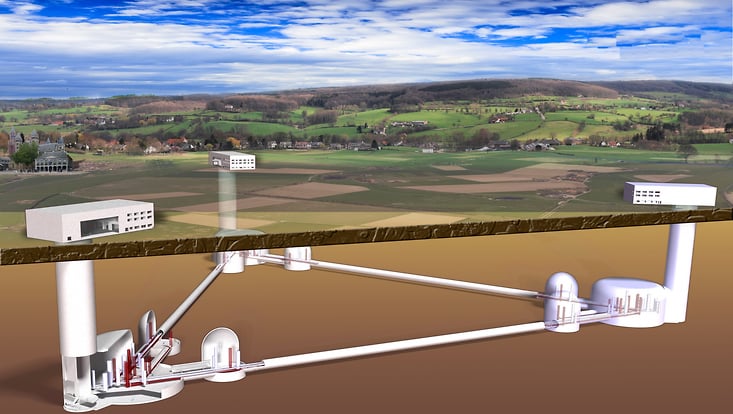
Photo: MPI für Gravitationsphysik/NIKHEF
Artistic rendition of the Einstein Telescope.
Oliver Gerberding, Professor of Physics and Principal Investigator at Quantum Universe, has been appointed Germany’s representative in the Einstein Telescope Forum of National Representatives. He succeeds Michèle Heurs, who held the position for the past three years.
In this role, Gerberding will represent Germany within the international Einstein Telescope (ET) collaboration and help coordinate scientific and organisational activities at both national and international levels. He will also serve as coordinator of the German Coordination Group for the Einstein Telescope, supporting the community in turning shared goals into concrete plans and milestones.
Over the next three years, Gerberding sees two priorities as particularly important. The first is securing long-term support for the project. Research infrastructures on the scale of the Einstein Telescope are planned and developed over decades. Coordinating research and technology roadmaps, and preparing proposals for sustained governmental funding, will therefore be a central task.
The second priority is preparing for the decision on the future location of the observatory. The site selection process is expected to conclude in 2027. Two out of three candidate regions are Saxony and the Euregio Meuse-Rhine region, both of which are either fully or partly located in Germany. Teams at all candidate sites are currently conducting extensive studies and preparatory work ahead of the final decision.
These efforts will help shape the future role of the German gravitational-wave community within one of Europe's most ambitious scientific projects and require close collaboration between universities, research institutes, funding agencies, and international partners.
The Einstein Telescope is a planned next-generation observatory for gravitational waves—small ripples in spacetime produced by some of the most energetic events in the universe, including collisions of black holes and neutron stars. Since the first direct detection of gravitational waves in 2015, researchers have gained a completely new way of studying the cosmos.
Compared with existing observatories, the Einstein Telescope is designed to be significantly more sensitive and to detect a broader range of gravitational-wave signals. This will allow scientists to observe more events, study them in greater detail, and investigate fundamental questions about gravity, matter under extreme conditions, and the evolution of the universe.
Gerberding is a Professor of Experimental Physics and Principal Investigator at Quantum Universe. His research focuses on the technologies that make gravitational-wave detection possible.
His group develops advanced laser interferometry and precision metrology techniques—methods that enable the measurement and control of extraordinarily small changes in distance, far smaller than the diameter of an atom. Such technologies are essential for future observatories like the Einstein Telescope, where detecting gravitational waves depends on measuring minute distortions of spacetime with exceptional precision.
With the Einstein Telescope, researchers expect to collect far richer gravitational-wave data than ever before. Over the coming decades, these observations could open new opportunities to test fundamental physics and deepen our understanding of some of the most extreme phenomena in the universe.

