Quantum Universe
Cluster of ExcellenceQuantum Universe
Photo: UHH/Laura Vogiatzis
6 May 2026
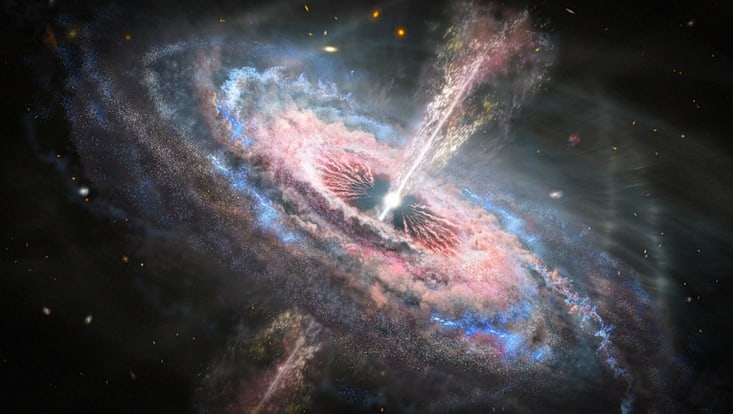
Photo: NASA, ESA and J Olmsted (STScI)
As more powerful observatories have allowed astronomers to peer farther back in time and push the observable edge of the universe closer to the Big Bang, they revealed that most, if not all, galaxies harbor supermassive black holes at their center. Clearly, black holes play a critical role in the formation and evolution of galaxies – but why and how? This question has kept many an astrophysicist and cosmologist up at night.
In a paper published in Nature, a team led by Weizhe Liu and Xiaohui Fan at the University of Arizona's Steward Observatory, with the support of Quantum Universe Key Researcher Jan-Torge Schindler, reports the discovery of an unprecedented number of exceptionally fast and powerful galactic "winds" streaming from quasars—distant galaxies whose bright cores are powered by supermassive black holes.
As the supermassive black hole at the center of a quasar galaxy voraciously gobbles up matter, it releases colossal amounts of energy. Considered the most energetic objects in the universe, it is not unusual for a quasar to outshine all other light sources in its host galaxy.
The study, published in Nature, could hold the key to a cosmological mystery: At very high "redshifts"—the farthest reaches of space and time, in this case within around two billion years after the Big Bang—astronomers had turned up an unexpectedly large number of young galaxies that stopped forming stars early on.
The likely culprits behind this process known as "quenching" Quasars. Cosmological simulations suggested that, with their blowtorch action, they rid their galaxy of its gas supplies, effectively shutting down the process of making stars. Until now, however, nobody had found a smoking gun, as only very few examples of quasars of the right age were known.
Using the James Webb Space Telescope, the research team scoured the high-redshift universe for quasars and observed 27 such objects from the time of one billion years after the Big Bang. Six of them stood out through exceptionally fast galaxy-scale winds, up to 8,400 km per second, which is extremely fast even for a quasar.
The survey suggests that quasars with extremely fast outflows were at least four times more common at higher redshifts (read, closer to the Big Bang) than at lower redshifts, and their average outflow rate of kinetic energy about 100 times higher compared to lower-redshift quasars.
The team believes that such "super quasars" could help explain the abundance of galaxies that stopped forming stars before their time in the early universe.
Dr. Jan-Torge Schindler, whose Emmy Noether Group at Hamburg Observatory investigates the formation and early evolution of supermassive black holes in distant quasars, is co-author of this work. He provided critical review and editorial feedback on the manuscript, contributing to the refinement and clarity of the publication prior to submission.