
Quantum Universe
Cluster of ExcellenceQuantum Universe
Photo: UHH/Denstorf
11 March 2026
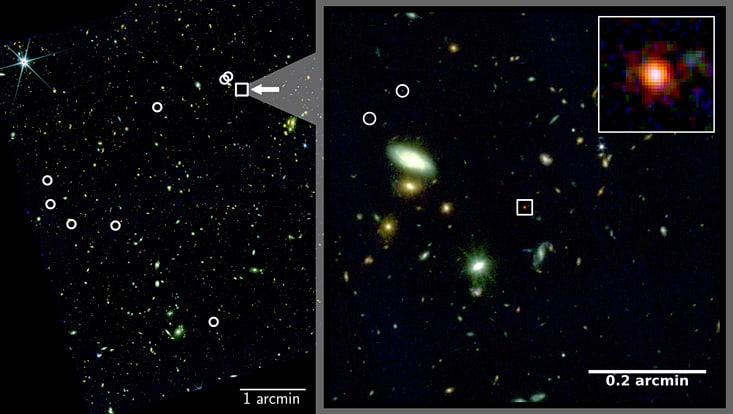
Photo: James Webb Space Telescope and UHH/MIN/Schindler
Researchers from the University of Hamburg, including Excellence Cluster Quantum Universe Key Researcher Dr. Jan-Torge Schindler, have discovered a so-called “Little Red Dot” in the early universe. This class of objects has only been known for a short time and could provide new insights into the formation and evolution of supermassive black holes. The initial findings have been published in the journal Nature Astronomy.
Supermassive black holes are directly tied to two key research areas of the Quantum Universe, dark matter and gravitational waves. One of the theories to explain the origins of massive supermassive black holes in the early universe proposes that they started from pockets of collapsed dark matter within the first second after the Big Bang, the so-called primordial black holes. Furthermore, mergers of supermassive black holes are key sources of gravitational waves. Measuring those signals with the upcoming Laser Interferometer Space Antenna (LISA) will provide key constraints on their early assembly.
Using the James Webb Space Telescope and a specially developed observation program, the researchers accidentally discovered a unique object belonging to the so-called Little Red Dots. Little Red Dots are a class of objects first identified in 2023 by the James Webb Telescope. They are currently understood to be a new variant of actively growing, supermassive black holes.
The newly discovered Little Red Dot was observed at an extremely high redshift of z=7.3. Redshift allows astronomers to determine the distance of cosmic objects. Because light from distant objects takes a very long time to reach Earth, redshift also allows us to look back in time. The Little Red Dot found by the Hamburg team exists in a period when the universe, now about 13.7 billion years old, was only 730 million years old—a time when only about a dozen supermassive black holes were previously known.
Supermassive black holes in the early universe pose a puzzle for researchers worldwide, as they appear too massive to have formed so early. The discovery of Little Red Dots, which seem to have less mass but are much more common according to projections, could help solve the mystery of supermassive black holes.
The Little Red Dot discovered by the Hamburg researchers appears as a compact, red-glowing source in images from the James Webb Space Telescope. Scientific analysis shows that the black hole in this object has a mass of almost 500 million times as much as the Sun—a huge mass for such an early time. What is particularly remarkable about this object is that eight additional galaxies were found in its immediate vicinity. This clustering suggests that the object is located at a node of cosmic structures.
“The study shows that supermassive black holes, like Little Red Dots, already existed very early in the universe and also grew in dense galactic environments,” says the study’s lead author, Dr. Jan-Torge Schindler. Until now, researchers have mainly studied the formation and early development of the universe using quasars. Quasars are extremely bright galaxies whose light is dominated by the growth process of supermassive black holes at their centers. It is precisely the billion-solar-mass black holes of quasars whose existence is so difficult to explain.
If the black holes of Little Red Dots grow in similar environments to those in which quasars are observed, this could indicate that supermassive black holes grow there over long periods, first appearing as Little Red Dots before becoming brightly shining quasars.
“Our results suggest that Little Red Dots could be hidden precursors to quasars. In this way, black holes could grow continuously over a longer period, despite the short lifespan as a quasar. This would help explain their high masses so early in the universe," adds Schindler.
In the long term, the researchers plan to identify more such objects as part of the James Webb program “COSMOS-3D” to better understand whether there is an evolutionary link between quasars and Little Red Dots. The goal is to trace the formation and development of supermassive black holes in the first billion years as accurately as possible.

