Quantum Universe
Cluster of ExcellenceQuantum Universe
Photo: UHH/Laura Vogiatzis
15 April 2026
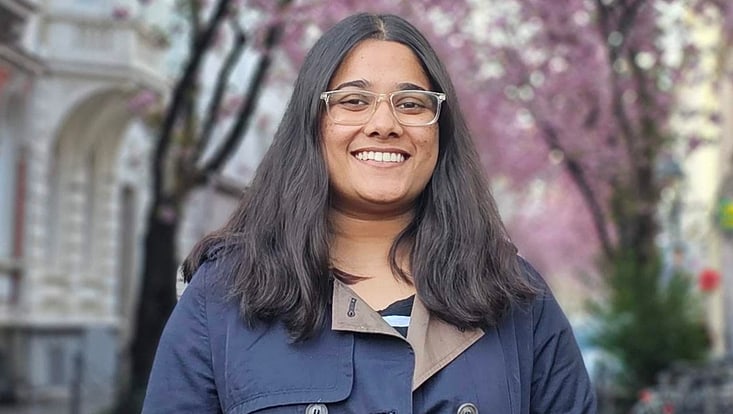
Photo: Chaki/Private
With a bachelor’s degree from India, Subarna decided to move to the University of Bonn to pursue a master’s in astrophysics where she worked on understanding what happened in the earliest moments of the universe. Since then, she has moved to Hamburg where she uses machine learning to study how astrophysical processes re-distribute matter on small scales and how it impacts the overall large-scale structure of the universe from a cosmological point of view. Read what she has to say about her journey and what pursuing a PhD means to her.
During my master's at the University of Bonn, I worked on understanding the early universe. Essentially studying what happened in the earliest moments of the universe, how it translates to what we know today, and testing whether our theoretical understanding holds up. My thesis, “Constraining the primordial power spectrum using a differentiable likelihood,” focused on probing the very first fluctuations in the universe.
Currently, I have shifted my focus to the late-time universe. I work under the supervision of Prof. Dr. Luisa Lucie-Smith on “Cosmology on small scales with machine learning.” I study the physics of visible matter and its impact on some of the largest gravitationally bound structures, such as galaxy groups and clusters. What excites me most is that I get to connect theory with observations and develop innovative approaches like using machine learning techniques to explore these questions.
I’ve been passionate about science, especially physics, from a young age. After completing my bachelor's in India, I was certain I wanted to continue with a master's, and astrophysics felt like the perfect choice. After all, studying the universe is one of the coolest things one can do.
During my master's thesis, I realized how rewarding research can be. While it can be challenging at times, the idea of solving mysteries of the universe and contributing even a small piece to our understanding is incredibly motivating. That’s what led me to pursue a PhD.
Starting a PhD has been an exciting experience: “amaze, amaze, amaze!” as Rocky says in Project Hail Mary. It’s both thrilling and a bit overwhelming, but in a good way.
I like how Hamburg has something for everyone. Whether you enjoy music, architecture, or nature, the city offers all of it. I really enjoy the harbour area, as well as spending time by the Alster. Being close to the sea and having such a vibrant harbour is amazing.
There’s also a bit of a running joke that physicists follow a bimodal distribution: you either boulder or you don’t. Since starting my PhD, I’ve clearly shifted toward the bouldering side so I also like spending time at bouldering gyms.
A typical day usually involves a mix of reading papers, coding, and trying to understand new concepts and playing with our observatory cat. A lot of time is also spent on debugging or figuring out why something doesn’t work as expected.
There are also meetings with my supervisor, as well as seminars and lectures. We also have dedicated machine learning meetings. No two days are exactly the same, which keeps things interesting.