
Quantum Universe
Cluster of ExcellenceQuantum Universe
Photo: UHH/Laura Vogiatzis
30 April 2026
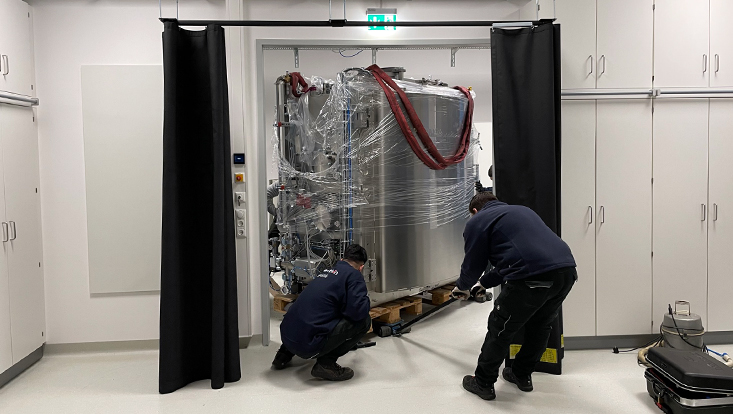
Photo: AG Gerberding
In April, the German Research Foundation (DFG) startet new funding for a new research group with the participation of the University of Hamburg. In addition to Prof. Celine Hadziioannou from the Department of Geosciences, Prof. Oliver Gerberding, a leading scientist in the Excellence Cluster Quantum Universe, is significantly involved.
The Earth rotates on its own axis — but not as uniformly as one might think. Changes in mass on and within the planet — such as the shifting of water masses due to tides or the melting of the ice sheets at the poles — influence its rotation. Measuring these fluctuations is the goal of a new DFG-funded research unit, which will receive approximately four million euros from the German Research Foundation over the next four years. Together, they aim to develop high-precision sensors for measuring Earth's rotation. Two research groups from the University of Hamburg — led by Dr. Celine Hadziioannou and Dr. Oliver Gerberding — are also participating in "RING: Rotational Movements in Physics, Geophysics, and Geodesy," headed by Prof. Dr. Heiner Igel at LMU Munich. They will collaborate on the co-development and further refinement of the optical measuring instruments known as ring lasers and on researching their application.
At the heart of the RING project lies a fundamental scientific challenge: while measuring the movement and deformation of objects in three-dimensional space is essential across many fields — from seismology and geodesy to space exploration, gravitational wave detection, and navigation — there is currently no transportable sensor capable of measuring the rotational components of ground motion at the level of seismic background noise below 1 Hz. The RING research unit aims to change this. The team plans to develop and test a passive ring laser gyroscope able to measure the rotational component of secondary ocean-generated seismic noise, while meeting a crucial design criterion: the sensor must be transportable, making it suitable for a wide range of field applications.
Findings regarding Earth's rotation have direct implications for science. "In combination with other seismic measurements, these sensors act like a stethoscope for our planet and allow us to understand how climate-related changes — such as shifts in groundwater — subtly alter the Earth's crust, thereby providing new insights into the effects of climate change on our planet," says Hadziioannou, who conducts research in the field of environmental seismology.
Gerberding adds: "Ring laser technology shares many similarities with gravitational wave detectors, and compact ring lasers also have the potential to reduce noise in observatories such as the future Einstein Telescope. Conducting joint research here is a win-win situation." The physicist conducts research on gravitational waves in the Cluster of Excellence Quantum Universe. The project thus forms an interdisciplinary link between the Department of Earth System Sciences and the Department of Physics.
You can find more information about the RING research group in the DFG GEPRIS project database.
Research Units (Forschungsgruppen) are funded by the German Research Foundation (DFG) to enable groups of researchers to pursue collaborative projects beyond the scope of individual research. Funded for up to eight years, they bring together expertise across institutions and disciplines to open up new lines of inquiry and develop innovative methods.

